What Is Brazilian Jiu-Jitsu (BJJ)? A Complete Beginner's Guide
New to BJJ? This beginner's guide explains what Brazilian Jiu-Jitsu is, where it came from, how it works, Gi vs No-Gi, belts etc.
So someone mentioned BJJ to you and now you want to know what it is. Whether it's that guy at work who keeps inviting you to train with them, or you saw two UFC fighters hugging each other on the floor, or you want to find out why all of Hollywood has started "jits", we'll provide you with all the answers to your questions about the fastest growing sport.
What Is Brazilian Jiu-Jitsu?
At its most basic, BJJ is a grappling martial art that prohibits striking. The core belief is that the most effective way to fight is to take your opponent down, control them, and finish with a submission hold.
The idea behind all of it is simple. A smaller, weaker person should be able to control and defend themselves against someone bigger and stronger by using technique alone. Size, strength and fitness all help, and nobody who trains will tell you otherwise, but they matter far less than knowing how to move and where to apply pressure. BJJ leans on that more than just about any other martial art. That's a big part of why it attracts people of every age, body type and background, and why some of the deadliest humans on the planet are also the most inconspicuous, à la Mikey Musumeci.
Where Did Brazilian Jiu-Jitsu Come From?
To cut a long story short, BJJ traces back to Japanese jiu-jitsu and judo. In the early 1900s a Japanese judoka named Mitsuyo Maeda travelled the world as an ambassador for the art, taking on all comers to prove it worked, and eventually settled in Brazil. There a businessman named Gastão Gracie helped him get set up, and in return Maeda taught Gastão's son Carlos.
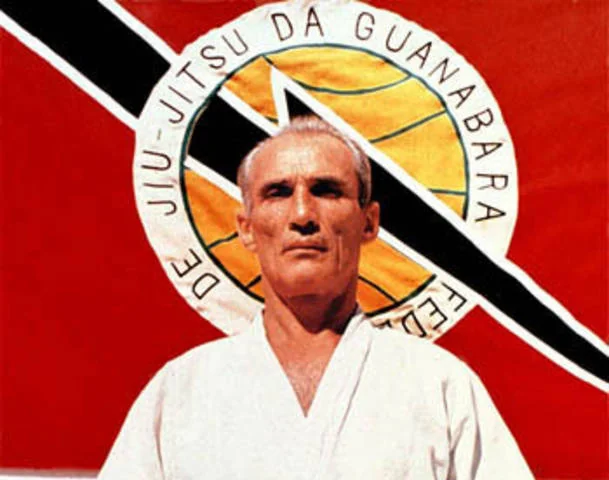
Carlos passed it on to his younger brother Hélio, who was smaller and physically weaker, so he optimised the system further, leaning even more heavily on leverage over strength and sharpening its focus on submissions, laying the foundations of the art we know today. The Gracies spent the following decades refining it, but the real explosion came at UFC 1 in 1993, when Royce Gracie beat a string of bigger opponents to win the tournament and showed the world exactly what BJJ could do. It's been evolving ever since.
How Does Brazilian Jiu-Jitsu Actually Work?
The basic idea behind BJJ is that almost every fight ends up on the floor sooner or later, and once it's there, the better grappler wins. John Danaher, the best coach the sport has ever seen, sums the whole thing up in four steps.
First, you take the fight to the ground, where your opponent can't hit you with anything meaningful. Then you get past their legs, because even flat on their back they can still kick, punch and lock you up in submissions. From there you work into a dominant position, aiming for something like mount or the back, where you're safe and they're in trouble. And finally you finish, whether that's a submission or, in a real fight, strikes.
The person on the bottom isn't just lying there taking it. They use their legs and arms to stop you getting past, which is what people mean by guard, and from there they can flip the position with a sweep or catch you in a submission of their own. Submissions can be attempted from almost any position, but they're far more likely from a position of dominance, which is why so much of BJJ comes down to winning the position before you even think about the finish.
Does Strength Matter?
Short answer, no. Long answer, yes.
It all depends on who's rolling. When one person is far more experienced than the other, strength barely comes into it. A fresh white belt can throw everything they've got at a higher belt and it won't matter, they'll be controlled, worn out and tapped before their strength ever gets a chance to do anything. That's the side of BJJ everyone falls in love with. But once both people actually know what they're doing, strength creeps back in, and if two grapplers are a similar level, the bigger, stronger one usually comes out on top.
It's part of the reason BJJ is the only combat sport that lets people of any size compete against each other. Everywhere else you're locked into tight weight classes, but BJJ competitions regularly run open-weight, or "absolute", divisions, where a smaller guy might find themselves across from someone three times their size.
Rener Gracie has a nice way of putting this, which he calls the Boyd System. The idea is that once someone's experienced, every 20 pounds they've got on you, and every ten years younger they are, is worth about a belt. So an experienced 200lb blue belt can feel a lot more like a brown belt to a 160lb one. It's a rough rule rather than a hard one, but it nails the point: against a beginner, size and age barely register, but between experienced grapplers they add up fast.
Why Do They Sit?
If you've watched jiu-jitsu, you'll notice people happily dropping to the floor and fighting off their back rather than staying on their feet. We can all agree it looks weird.
The ground is the most technical part of jiu-jitsu and, for most people, the most fun, it's where they fall in love with it in the first place. It's practical, too. Takedowns need room and send bodies crashing down, so when the mats are packed you can't have everyone slamming each other around. Start on the floor and far more people can train safely in far less space, which is why most gyms spend the bulk of their time down there.
In competition it goes a step further. In a lot of sport BJJ, especially in the gi, you lose nothing by sitting down and playing off your back, so plenty of competitors skip the takedown battle altogether and pull guard, dropping straight to the position where they're most dangerous. Done well it's a legitimate, high-level game, and plenty of world titles have been won from off the back.
Gi vs No-Gi
BJJ is trained in two main formats, and most gyms offer both.
Gi training uses the traditional kimono-style uniform. The jacket and trousers give you and your opponent plenty to grip, which tends to make the game slower and more methodical. No-Gi removes those grips. You train in a rash guard and shorts, movement is faster, and scrambles happen more often.
Neither is better than the other, and plenty of people train both because they develop different skills. The Gi is the more technical, while No-Gi is the more pragmatic. If you're not sure which to start with, go with the Gi, it will give you the best foundational learning for the sport.
Understanding the Belt System
For adults the belt order runs white, blue, purple, brown and black, and working through them is a slow business, nobody flies up the ranks in jiu-jitsu. Each belt roughly marks where your game is at. White is where everyone starts, surviving and soaking it all in. By blue you've got real, working jiu-jitsu, the Gracies always said a blue belt should be able to handle a bigger, untrained attacker, and that's a fair benchmark. Purple is where you stop just collecting techniques and start building a game of your own. Brown is essentially a black belt with a few rough edges left to tidy up. And black is the belt of legitimacy, the one that tells the world you genuinely know what you're doing.
Getting there is deliberately slow, and that's the point. Unlike a lot of martial arts there's no set time period or formal grading between belts, your coach promotes you on your technical ability, consistency, understanding and attitude over time. Timelines vary massively, one person might spend two years at a belt while another spends five, and a black belt usually takes somewhere around ten years.
After black belt it changes. Promotions become degrees, marked by stripes on the belt, and eventually the red-and-black coral belts and beyond, but these are handed out mostly on time served rather than a jump in skill. By then you've long since proven you can fight, so the later ranks are really about your years on the mats and what you've given back to the art.
Why Do So Many People Get Hooked on BJJ?
Ask anyone who's trained for a few years why they keep turning up and you'll rarely get the same answer twice, but a few things come up again and again.
The first is that it's basically human chess. Every round is a moving puzzle, you're constantly making decisions, reacting to what your partner does and hunting for a better solution, and even after years on the mats there's always something new to work out. Some people are chasing that, some are chasing competition, and plenty just love the problem-solving for its own sake.
Then there's the escape. Jiu-jitsu demands 100% of your attention, and very few things in life actually do that. When someone's trying to strangle you, there's no room left to think about your inbox, your bills or whatever's stressing you out, so an hour on the mats ends up being about the best therapy session going. You leave with a clear head and, usually, drenched, the calories you burn are ridiculous and everyone walks off sweating buckets.
It toughens you up, too, in a way that spills into the rest of your life. BJJ constantly puts you in bad, uncomfortable positions and forces you to stay calm, work the problem and find a way out, and eventually a way to win. It's the safest place in the world to get beaten up, you learn to be comfortable being uncomfortable, and somewhere along the way you quietly pick up the skills to handle yourself. You learn, more or less, how to be a ninja.
And then there's the community. Training partners become friends fast, because you're relying on each other to get better, spending hours solving hard problems together, celebrating each other's promotions and dragging each other through the rough patches. For a lot of people the gym stops being a gym and turns into the place they most look forward to all week.
Stop scrolling, start rolling
Book your first class today
No membership, no commitment, no experience needed.
Find a class on DOJOTAP